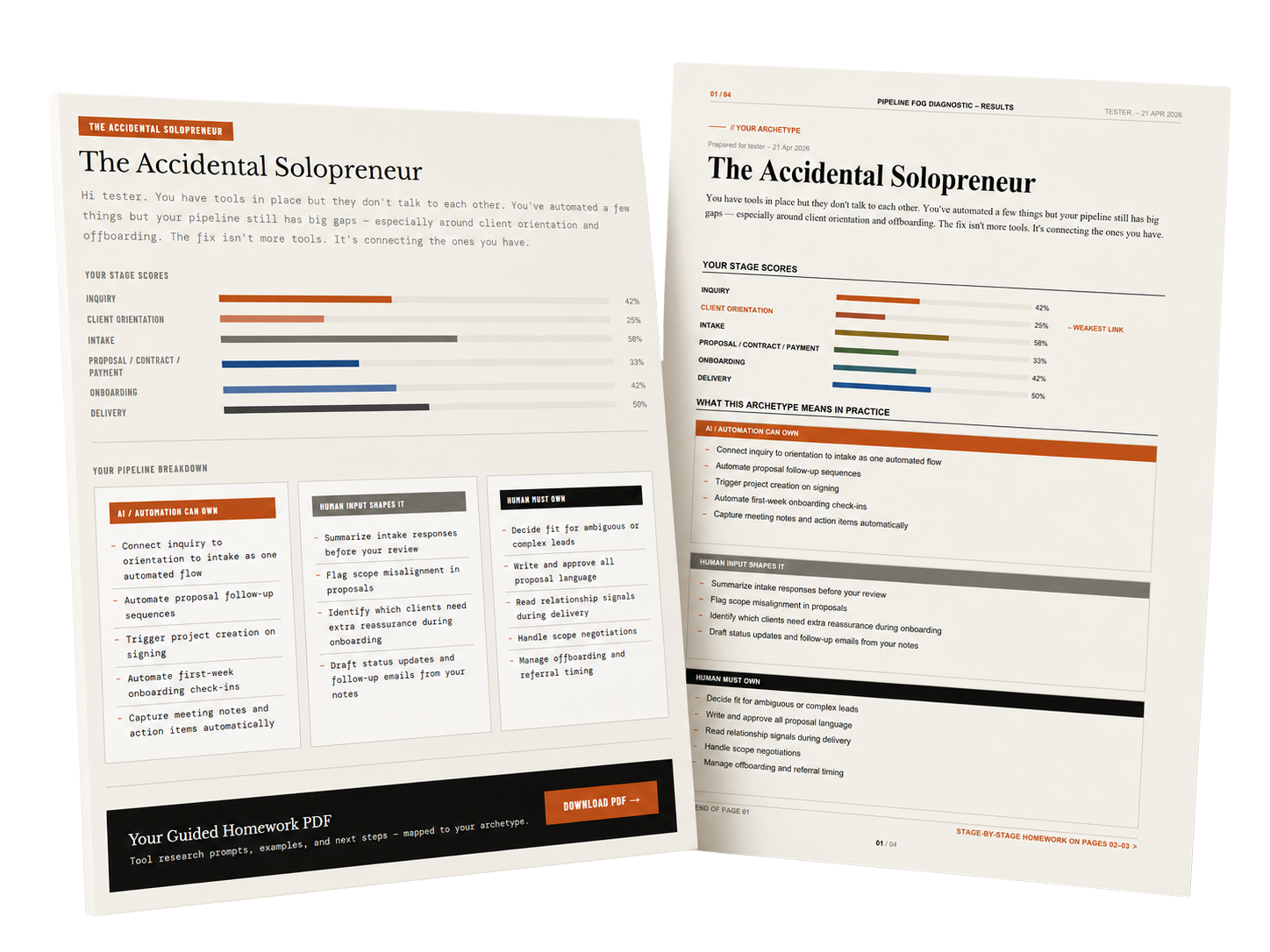
Most of what's eating your week isn't the work clients pay you for — it's everything around it. The proposals from scratch. The same answers to every new client. The "wait, is that included?" mid-project. None of that is you being bad at this. It's a missing piece. Building that missing piece is what this practice does.
18 questions, about 4 minutes. Find out exactly where your week is going — and what to fix first.
Free. Personalized results. No spam.
Every business has a path a client travels through it. The first message. The discovery call. The proposal. The contract. The deposit. The welcome. The kickoff. The questions. The check-ins. The revisions. The handoffs. The wrap-up. The invoice. The follow-through.
That's the bulk of what running a service business actually is. Not the work clients pay you for — the work around the work. And right now, you're personally doing every single piece of it. From memory. From scratch. Every time a new client shows up.
So of course it feels like a job. You're not bad at running a business — you're running it manually. Every step. Every time. With no shape underneath it. That's not a discipline problem. That's a structure problem. And structures can be built.
Here's what nobody warns you about: this gets worse with success, not better. Four clients is barely manageable. Eight is impossible. Most freelancers hit a ceiling and assume they need to work harder. They don't. They need to stop being the person doing every piece of the path. That's the part this practice fixes.
The work clients pay you for is yours. The rest of it doesn't have to be.
Eighteen questions about how you work with clients, from first message to final invoice. Find your specific weak spot — and what to do about it this week.
Most people finish in about four minutes. The results are specific to you — not generic advice.
Free. Personalized results. No spam.
Most solopreneurs try to fix a chaotic week with another tool. A new project manager. A different CRM. Some new AI thing everyone's talking about. The week stays just as chaotic, and now there's another subscription.
The fix is sequenced. First, you write down how you actually work. Then you pick the tools that fit what you wrote down. Then — and only then — you set up the parts that can run without you. Most people try to do step three first. That's why nothing sticks.
Most freelancers are stuck on step three because nobody told them about steps one and two. This practice exists to walk you through them in the right order.
These aren't opinions. They're the numbers from research on the same kind of solopreneurs reading this page. If you've felt any of this, the data has receipts.
Almost nine out of ten. Thirteen percent of them quietly switch to a competitor before the real work even starts. If your new clients have ever gone weirdly quiet in the first two weeks, this is probably what happened.
Lost to switching between apps and answering the same questions from memory. At a hundred dollars an hour, that's about thirty-nine thousand dollars a year of your time, evaporating into the gap between five tools that don't talk to each other.
They're not wrong about what they've seen — most AI advice is built for companies with twenty employees and a tech team. They're wrong about what's possible. This is one of the gaps this practice exists to close.
20+ years in high-touch client operations. Using AI in operational work since 2022 — before it became a marketing trend. I'm still in the same corporate world a lot of solopreneurs are transitioning out of — and I built this practice because I had the same problem they have.
I run my own consulting practice on the exact same stack I build for clients. HoneyBook, NotebookLM, ClickUp, Zapier — ~$19/month. No mandatory discovery calls before contract. Fully automated from inquiry to onboarding. This is proof of concept, not theory.
Full background